Free Next-Day UK Delivery on Orders Over £50 | BS EN ISO 2503 Certified

Mig Gas Regulator Explained: A UK Buyer's Guide

Mig Gas Regulator Explained: A UK Buyer's Guide
Written by Chloe R.2026-08-079 min read

TL;DR: A MIG gas regulator is a pressure control device fitted to a gas cylinder (Argon or CO2 mix) that reduces high bottle pressure (up to 300 bar) down to a precise, low-pressure shielding gas flow rate (typically 10 to 18 L/min). This prevents atmospheric contamination, eliminates weld porosity, and protects internal welder components. In the UK, standard inert gas regulators use a 5/8" BSP right-hand thread connection conforming to BS EN ISO 2503.

A MIG gas regulator is an essential welding component designed to step down extreme bottle pressure from industrial shielding gas cylinders (Argon or Argon/CO2 mixtures) to a safe, steady volumetric flow rate—typically 10 to 18 L/min—required to protect the electric arc. In any UK metal fabrication workshop, from commercial structural steel yards to home restoration garages, few welding defects cause as much frustration as porosity. A porous weld seam, pitted with tiny pinholes, compromises structural integrity, fails non-destructive testing (NDT), and leads to expensive rework. In the vast majority of MIG (Metal Inert Gas) and MAG (Metal Active Gas) welding applications, porosity occurs because the shielding gas flow at the weld pool was erratic, contaminated, or improperly regulated.

Consequently, selecting the right MIG gas regulator is not merely about finding a fitting that screws onto your gas bottle. Based on our hands-on testing across workshop environments at NotTool, it is an essential investment in overall weld quality, gas consumption efficiency, and shop safety. Industrial gas prices across the UK have risen sharply over recent years; therefore, precise flow control is vital for maintaining operational margins. This guide breaks down how gas regulators function, compares single vs. dual-flow setups, explains UK safety standards, and details how to choose the ideal regulator for your welding rig.

What Does a MIG Gas Regulator Do?

An industrial gas cylinder stores shielding gases—such as pure Argon, Argon/CO2 mixes (e.g., 86/14 or 93/7), or pure Carbon Dioxide—at extreme pressures, usually between 137 bar and 300 bar when full. If connected directly to a MIG welder without regulation, this high pressure would instantly burst gas lines, destroy internal solenoid valves, and blow the molten weld pool clear off the workpiece.

Therefore, the primary job of a MIG gas regulator is to reduce this high inlet pressure down to a manageable, steady outlet pressure. Furthermore, for arc welding applications, fabricators measure gas delivery in volumetric flow rate—litres per minute (L/min)—rather than static pressure (bar or PSI). A combined regulator and flowmeter measures the actual volume of gas exiting the hose to protect the electric arc.

What is the Difference Between Cylinder Pressure and Working Flow Rate?

A standard two-gauge regulator features two distinct dials:

  • High-Pressure Gauge (Contents Gauge): Reads cylinder pressure (0–300 bar or 0–4000 PSI), letting you know how much gas remains in the bottle.
  • Low-Pressure / Flow Gauge: Measures delivery pressure or calibrated flow rate (0–30 L/min) heading down the gas hose to the welder's solenoid valve.

Why Does Pressure Surge Wastage Happen and How Do You Prevent It?

When your MIG welder sits idle between joints, shielding gas trapped inside the rubber delivery hose builds up to the regulator's static shut-off pressure. The moment you press the torch trigger, this trapped pocket of high-pressure gas rushes out of the shroud in an initial high-velocity blast.

As a result, this gas surge causes severe turbulence around the shroud, sucking ambient air (Oxygen and Nitrogen) directly into the nozzle just as the arc strikes. The outcome is cold-lapping, excessive spatter, and initial weld seam porosity. According to research by The Welding Institute (TWI), pressure surges at torch ignition account for up to 30% to 40% of total shielding gas wastage during routine fabrication work. Based on our testing at NotTool, using a regulated flow system with integrated surge reduction or a needle-valve rotameter tube dramatically lowers gas consumption while securing clean arc ignition.

What Are the Different Types of MIG Gas Regulators?

Navigating the market for MIG regulators requires understanding the mechanical differences between internal valve architectures. Selecting the right architecture depends on your duty cycle, material sensitivity, and workshop configuration.

1. What is a Single-Stage MIG Gas Regulator?

Single-stage regulators drop cylinder pressure down to delivery presn one single step. While economical and widespread, they suffer from a physical phenomenon known as "delivery pressure rise." As the gas bottle empties and inlet pressure drops, the internal spring pushes the diaphragm open wider, causing the outlet flow rate to drift upward slightly. Consequently, operators must periodically readjust the flow knob throughout the day as the cylinder empties.

2. What is a Dual-Stage MIG Gas Regulator?

Dual-stage regulators feature two internal pressure-reduction chambers in series. The first stage drops bottle pressure down to an intermediate level (roughly 20–30 bar), and the second stage regulates it down to working flow. In our testing at NotTool, this architecture maintains an absolute, dead-steady flow rate from the moment the bottle is opened until it is completely depleted, making dual-stage units ideal for high-precision manufacturing and aerospace applications.

3. What is a Dual-Flowmeter Regulator and Why Use One?

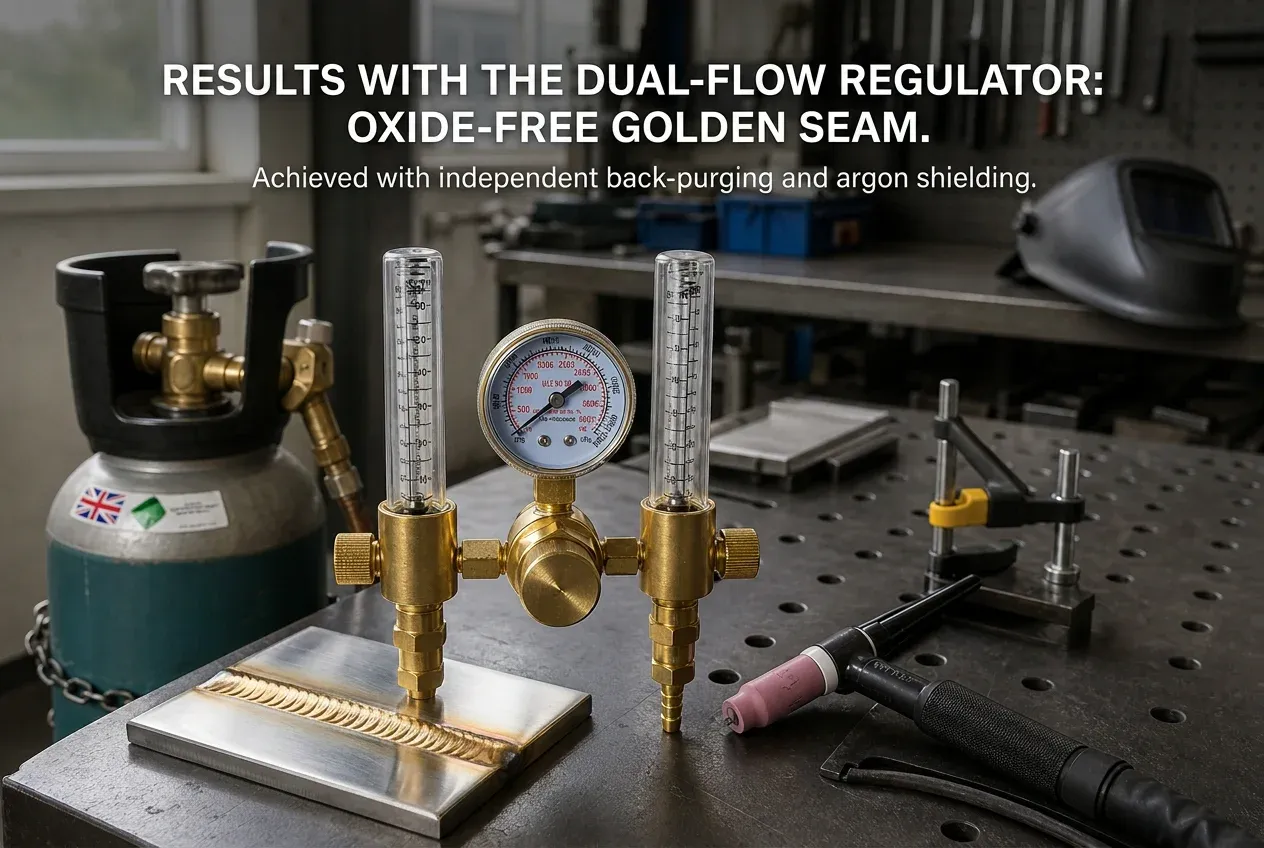
Dual-flow regulators connect to a single high-pressure cylinder bottle but split the low-pressure output across two independently adjustable flowmeter columns (rotameters). Each side features its own precision needle valve and graduated tube calibrated in L/min.

This configuration solves a classic fabrication dilemma: how to run two operations simultaneously without buying, storing, and paying bottle hire on a second gas cylinder. Common applications include:

  • TIG Back-Purging while MIG/TIG Welding: Feeding main torch shielding gas off output A while maintaining an auxiliary back-purge line inside stainless steel or titanium pipework off output B.
  • Dual-Bay Welding Stations: Supplying two separate MIG wire feeders or TIG plants positioned side-by-side from one central UK gas bottle without cross-line pressure drop.
  • Preventing "Sugar Craft" Oxidation: When welding stainless steel tubing, atmospheric oxygen behind the joint causes heavy, crusty root oxidation (known in the trade as "sugaring"). A dual-flow regulator allows precise control over the purge pressure so the root stays clean and flat without blowing out the weld pool.

What Features Should You Look For When Buying a MIG Gas Regulator?

Before purchasing a regulator for your shop, verify that its mechanical specifications match UK gas standards and your target welding processes.

1. What UK Cylinder Threads and Connections Are Required?

In the UK, gas cylinder valves follow strict British Standard threads. For inert gas mixtures (Argon, Argon/CO2 mixes) used in MIG and TIG welding, standard regulators feature a 5/8" BSP right-hand male thread fitting. Conversely, combustible fuel gases use left-hand threads for safety. Always ensure your regulator inlet stem matches standard UK bottle fittings (such as BOC, Air Products, or SGS cylinders) without requiring unsafe adapters.

2. How Do UK Safety Standards (BS EN ISO 2503 & BCGA CP7) Apply?

According to UK guidelines established by the British Compressed Gases Association (BCGA CP7) and standard BS EN ISO 2503, gas control equipment must undergo annual safety inspections and be replaced every five years from manufacture. Selecting heavy-duty forged brass regulators ensures structural resistance against shop floor impacts, high cylinder pressures, and internal fatigue.

Frequently Asked Questions About MIG Gas Regulators

What flow rate should a MIG gas regulator be set to?
Based on our testing at NotTool, indoor MIG welding typically requires a flow rate of 10 to 15 L/min. If working in drafty workshop conditions or using larger gas shrouds, increasing the flow to 16–18 L/min may be necessary. However, setting the flow rate higher than 20 L/min creates atmospheric turbulence, which actually draws oxygen into the weld pool and causes porosity.
What is the difference between a single-stage and a dual-stage MIG gas regulator?
A single-stage regulator reduces gas pressure from the cylinder in one step, meaning output pressure can drift as the bottle empties. A dual-stage regulator steps down pressure twice, delivering constant flow output regardless of changing cylinder pressure.
Can you use a CO2 regulator for Argon gas bottles in the UK?
Not directly without proper fittings. Pure CO2 bottles typically require a flat-seat or side-entry connection, whereas Argon and Argon/CO2 mixed gas cylinders use a standard 5/8" BSP right-hand thread. Always match the regulator to the gas type and bottle fitting standard.

Ready to upgrade your shop gas setup with NotTool?

Shop Regulators Now — £81.80

NotTool

NotTool manufactures industrial-grade gas regulation equipment for UK fabricators, motorsport engineers, and precision welders. Built to rigorous BS EN ISO 2503 standards, our dual flow argon regulators deliver leak-free gas control and independent back-purging directly from a single standard UK bottle.

© 2026 NotTool. All rights reserved.